

Magnetic Clutch On Automobile
 |
| Magnetic Clutch |
Single-face clutches make up approximately 90% of all electromagnetic clutch sales.
Electromagnetic clutches are most suitable for remote operation since no mechanical linkages are required to control their engagement, providing fast, smooth operation. However, because the activation energy dissipates as heat in the electromagnetic actuator when the clutch is engaged, there is a risk of overheating. Consequently, the maximum operating temperature of the clutch is limited by the temperature rating of the insulation of the electromagnet. This is a major limitation. Another disadvantage is higher initial cost.
How it works
Engagement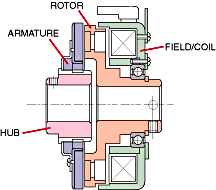 |
| Magnetic Clutch |
When current is removed from the clutch, the armature is free to turn with the shaft. In most designs, springs hold the armature away from the rotor surface when power is released, creating a small air gap.
Cycling is achieved by interrupting the current through the electromagnet. Slippage normally occurs only during acceleration. When the clutch is fully engaged, there is no relative slip, assuming the clutch is sized properly, and thus torque transfer is 100% efficient.
This type of clutch is used in some lawnmowers, copy machines, and conveyor drives. Other applications include packaging machinery, printing machinery, food processing machinery, and factory automation.
When the electromagnetic clutch is used in automobiles, there may be a clutch release switch inside the gear lever. The driver operates the switch by holding the gear lever to change the gear, thus cutting off current to the electromagnet and disengaging the clutch. With this mechanism, there is no need to depress the clutch pedal. Alternatively, the switch may be replaced by a touch sensor or proximity sensor which senses the presence of the hand near the lever and cuts off the current. The advantages of using this type of clutch for automobiles are that complicated linkages are not required to actuate the clutch, and the driver needs to apply a considerably reduced force to operate the clutch. It is a type of semi-automatic transmission.
Electromagnetic clutches are also often found in AWD systems, and are used to vary the amount of power sent to individual wheels or axles.
A smaller electromagnetic clutch connects the air conditioning compressor to a pulley driven by the crankshaft, allowing the compressor to cycle on only when needed.
Thank You happy blogging :)



0 Ulasan